
Folks—
Agents are all the rage today. Agent this , agent that— I would submit that YOU and YOUR investments are your own BEST agents. Your investments work for you— day and night. They do the heavy lifting with a single laser focussed goal, to make you financially free.
There is a lot of doom and gloom out there, and with good reason. There is uncertainty, all this uncertainty can be unnerving, and to make it worst, influencers with little to no skin in the game are spreading FUD at all hours. Against such a backdrop of non stop fear mongering, a consistently implemented investment program is hard, if not impossible. Many give up, most do not even get started.
If there is one key takeaway from my posts — I believe that we are as a system, or a society are going to figure out myriad of these issues. I am consistently going to DCA and add on dips into my long term accounts, and I am going to have money on the side to be able to partake in next monster winner like PLTR, Micron, NVDA, or a Moderna. This is not going to change any time soon. Yes, I am a permabull when it comes to accumulating the likes of SCHD, VTI, VOO, VT, SCHG, SCHF. You name it. And yes, I can be bullish on bearish on single stock names. It is all about the time frames.
Because what really is the alternative? To spend it all? To have no skin in the game? To hoard cash?
Is cash really going to be all that rage if the world is indeed ending as some of these doom peddlers will have you believe? I would submit Gold will do far better in such an all out disaster scenario.
When it comes to long term investing, my motto is very simple— no one knows anything over long periods of times and price paid does not matter in the long run. This leads me to only one logical conclusion— A DCA like approach implemented over several years, regardless of price.
Let’s kick off the post with a high level view of what’s driving the current narrative, and then dive into some of the levels of interest in various markets..
The PMIs here in the US and elsewhere came in pretty perky this week, painting a picture of just how strong corporate America continues to be. On Wednesday, the U.S. flash Composite PMI came in at 58.4, up from 56.0 in August and the strongest reading in more than five years. Germany came in much better than expected, France slid back into expansion and the other Eurozone numbers across the pond were pretty robust as well.
Now juxtapose this against the consumer-facing numbers and the contrast could not be starker. Consumer sentiment for most part remains terrible. The preliminary University of Michigan reading for September fell to 47.8, down 13% from a year ago. Folks remain worried about inflation, jobs, cost of living and generally pessimistic about the inflation trajectory. At the same time you have this massive technology and AI spending boom going on where, at least from the corporate side, things look about as good as they come in a long-long time.
It is almost like there are two different economies operating at the same time — one for the haves and the one for the have-nots.
Now I would be careful in saying that the households remain laden in debt with absolutely no hopes. While the actual household debt is near historic highs and sits around $19 trillion dollars, in terms of relative disposable income and wages, this is not as elevated as prior extremes seen.
One obvious side effect of all this econ data was another move higher in sovereign yields across the board. Whether you look at Treasuries here in the U.S., gilts in the U.K. or government bonds elsewhere in Europe, the direction over the last several weeks has generally been the same: higher yields as markets digest stronger growth, elevated energy prices and the possibility that inflation is going to prove harder to kill than previously thought. That took some of the starch out of stocks and other risk on stuff on Wednesday, which had been sitting in a pretty comfortable position going into week.
The dynamic between these PMIs and their potential impact on inflation numbers is that I believe we will see some pressure on the long bonds going thru end of this year and I continue to think that a 5.5% on the ten year is possible though it remains to be seen if this holds. To be 100% clear, I am not saying it gets there or stays there, but with the 10-year already around 5%, it is no longer some ridiculous number that belongs in the tail-risk bin.
The FED only last week raised rates by 25 BPS, its first raise in over 3 years and more importantly this was a unanimous decision. I think the FED will predictably raise rates may be atleast once more, if not more. And therein lies the rub.
The surge in long bond yields has some believing that older, more affluent boomers will take advantage of this and sell stocks to buy bonds offering guaranteed income. While I can see the appeal of that narrative—we do not yet see it materializing in a way that is meaningfully blunting the downward pressure on bonds.
I think the sheer outperformance of stocks over the past few decades makes this a bitter pill for many boomers to swallow. My guess is that most will stay long the course.
Now, if stocks were to shed 10-15% from here, I do think some of them would sell and rotate into fixed income. And that is where you could get an extra layer of selling pressure in stocks, if and when that rotation starts to materialize.
To understand the quandary of current situation, let us rewind a couple of years back to the end of 2024.
Inflation here in the US had come down a long way from a peak of about 9%. Inflation was slowly but steadily going back towards that magical FED 2% milestone. Headline CPI ended 2024 at 2.9%, with core CPI still at 3.2%. At the same time, stocks were around record highs, helped enormously by the AI investment boom.President Trump is elected, we have some skirmishes as far as the trade wars go, which is part and parcel of his style of governance— there are dips and these dips get bought up.
Now while it is near impossible to prove, but I think the path for both inflation and markets would look materially different today without the energy shock of 2026. Would CPI necessarily be below 2%? Nobody knows. Would the S&P necessarily be above 8500? Again, nobody knows. But it is hardly a controversial thing to say that $100 oil, record diesel prices and higher transportation costs make the Fed’s job more difficult than $50-$70 oil would.
While I believe post-mortems are rarely useful in markets, I believe all of this matters because underneath all of this, I continue to think this market wants to go higher atleast one more leg.
What you instead end up is 2 narratives for this market— inflation related worries are sitting on the growth story keeping markets capped at 7800, and at the same time, you have an enormous CAPEX in the pipeline which is a robust catalyst for the bulls.
Oil remains a far bigger risk to the party than any rate hike.
$60 or so a barrel of oil is the sweet spot in my view. Oil at $60, gas closer to $3 or so in the US keeps the economic engine lubricated and humming, no pun intended.
When was the last time really we saw Oil anywhere near $60 a barrel? It has spent far more time hovering here near 100 than even 70. So to me a lot of this just seems amateurish stuff or reeks of deliberately trying to make it harder than it has to be.
For instance, several lawmakers have pushed for one, and the administration has considered various options, but it has so far resisted an outright ban.
If this is true, then I am afraid to say this is an extremely ill thought out move as it will guaranteed raise the prices of not just diesel but gas as well. For many of these refineries, the input materials as well as processes to make both diesel and gasoline are nearly identical. Refineries produce multiple products from the same barrel of crude. Gasoline, diesel, jet fuel and other products are produced together, and the economics of running a refinery depend on being able to sell that entire spectrum of end product.
Right now if the excess diesel, in excess of domestic consumption is not exported then it cannot autonomically be stored. Even if it can be stored, it will lead to a domestic glut inside the US and a famine of diesel outside the US. The refineries will have to shut down to avoid domestic glut which will ironically remove supply and raise prices— both internationally and potentially domestically.
You can almost see this at play when despite positive Iran-US messaging during the week, oil barely budged. I think if this diesel ban goes thru, it will actually lead to higher energy prices, not lower though initial knee jerk reaction could be to see some respite for diesel prices here in the US but rest of the world should brace for impact in form of much higher prices.
The other elephant in the room this week was much weaker than treasury auction.
In particular the 5-year Treasury auction was, by almost any measure, a pretty ugly one. It is not a stretch to call it a flop.
The auction tailed by roughly 3 basis points, bid-to-cover came in weak, foreign and institutional demand was poor, and dealers were forced to take down a larger share than usual. Now, I would not pin the entire bond selloff on one bad auction, because yields were already moving sharply higher on stronger economic data and renewed inflation concerns, but the auction certainly did not help. If anything, it reinforced the broader message the bond market has been sending lately: buyers want a much higher yield to absorb this amount of Treasury supply, and that is not exactly a friendly backdrop for long-duration equities.
Is NVDA a trap?
One interesting development recently has been the rising cost of insuring the debt of several AI-related companies through credit-default swaps. This includes widening spreads to insure NVDA’s debt — the company has been on a mission to fund all sort of investments around AI. Now in this moment in time, I do not read much into this but this is a reminder that investing class has begun to take notice and may be we have a real crisis in 1-2 years down the road, not for NVDA but may be for other less endowed players (CoreWeave and Oracle as examples).
The other interesting thing is NVIDIA’s valuation itself.
For a company producing astro growth numbers like NVDA, her forward earnings multiples have been remarkably low. Which begs the question— is there a red flag in NVDA earnings?
Now a 19 forward PE is not “cheap” in the traditional sense per se, but compared with 106% revenue growth and more than 100% year-over-year earnings growth, it is certainly highly unusual.
Skeptics have Jensen saying on tape that “NVDA is the world’s first and only growth value stock”. Whatever that means.
Depending on which side you sit, there are two very different interpretations:
Potentially bullish: earnings are simply growing much faster than the stock. If EPS keeps compounding anywhere near current rates, a ~20–30× P/E can look surprisingly cheap.
Potentially bearish: the market may believe current earnings are near a cyclical/AI-capex peak. A low forward P/E can be deceptive if today’s EPS estimates eventually get cut.
I would actually interpret NVDA’s unusually modest P/E as the market saying:
“We believe these earnings, but we’re not willing to assume they grow like this forever.”
This is going to be a problem as this market thinks that while the current growth may be almost a 100%, within a 2-3 year time frame, the growth will slow.
At some point NVIDIA will run into the law of large numbers. A company approaching hundreds of billions of dollars in annual revenue cannot compound at 100% forever. You know this, I know this, the market knows this. So the argument is not really about whether growth slows; it obviously will. The argument is about whether it eventually settles at 50%, 25% or something even lower.
Do you think it will be a problem for a cyclical stock like NVDA?
You bet.
At the same time, I think outright NVDA shorts can easily find themselves in a pickle if the broader market stays bid and AI spending continues to surprise to the upside.
This is why I have been so hesitant to outright short NVDA, and I have been playing this on dips.
For me, the cleaner way to approach this market is not necessarily to make a heroic call on the exact top in NVDA. I would rather look around the AI ecosystem for other companies that can shine here, without requiring NVIDIA’s current growth rate to continue indefinitely. I mean, look at META and MSFT— both are mega caps and both are up double digits within a both months from orderflow support levels shared right here in the Stack. PLTR has doubled in weeks from my support levels.
Emini levels
For those of you active in shorter time frames, like weeklies and intraday, if there is one key takeaway from my post, it is this— future expectations of volatility will drive these markets in the short term.
Why is that? If other time frame traders, who often happen to trade size do not believe there is going to be significantly volatility they may not have resting orders far from current prices which is an intent to trade away from the market. So you will see a dearth of orders at 7300 for instance because no one really believes that the market is going to trade 7300s any time soon— and at a basic level, this interplay of expected movement and actual movement is what creates a market. This becomes a self fulfilling prophecy if you will, since the market has to move wherever it can facilitate maximum trading.
A lot of guys make a mistake and forget this and it is an expensive mistake. Always remember— the primary function of a market is to make a market which is to say that it will try and match maximum number of buyers and sellers.
Once you wrap your head around this key orderflow concept, you will begin to see price action in a new light. This is the very phenomenon that creates Low volume nodes, High volume nodes, gaps, fair value gaps, or even dojis, inside bars, and hanging man, and a myriad of other patterns that chart traders may be aware of.
In light of this, the current low volatility conditions, with balancing at the highs, I think signals a market that wants to continue (for now) in direction of current dominant trend. This is why dips have been shallow and volatility has been pretty much non existent. My current view remains that this is an up-trending market with possibility that the dips could be bought. Now where we may differ is how much of a dip is a good dip and how much of a dip is bad?
Well, for starters I think a dip into 7350-7403 can be a very nice set up for swing time frames. For a move back into 7800s. Now this may appear a mirage, given every little dip recently has been purchased, but you never know. All we need is a nudge and the crowded trade can disperse.
To get to 7403, we will need some help from the smaller time frame traders. And I think this will look like series of closes here below 7700-7750. We are now 7810. These are emini December prices.
Minus this, if we cannot close below 7700, I will give the bulls a benefit of the doubt, and I think we can retrace back to recent contact highs near 7906.
Short term
In short term, I like Unity to be suported on any pullbacks but line in sand at $36. It is about $40 now. I think short term $50 is poss.
This is an older orderflow stock first shared in Stack at 20 or so. See below.
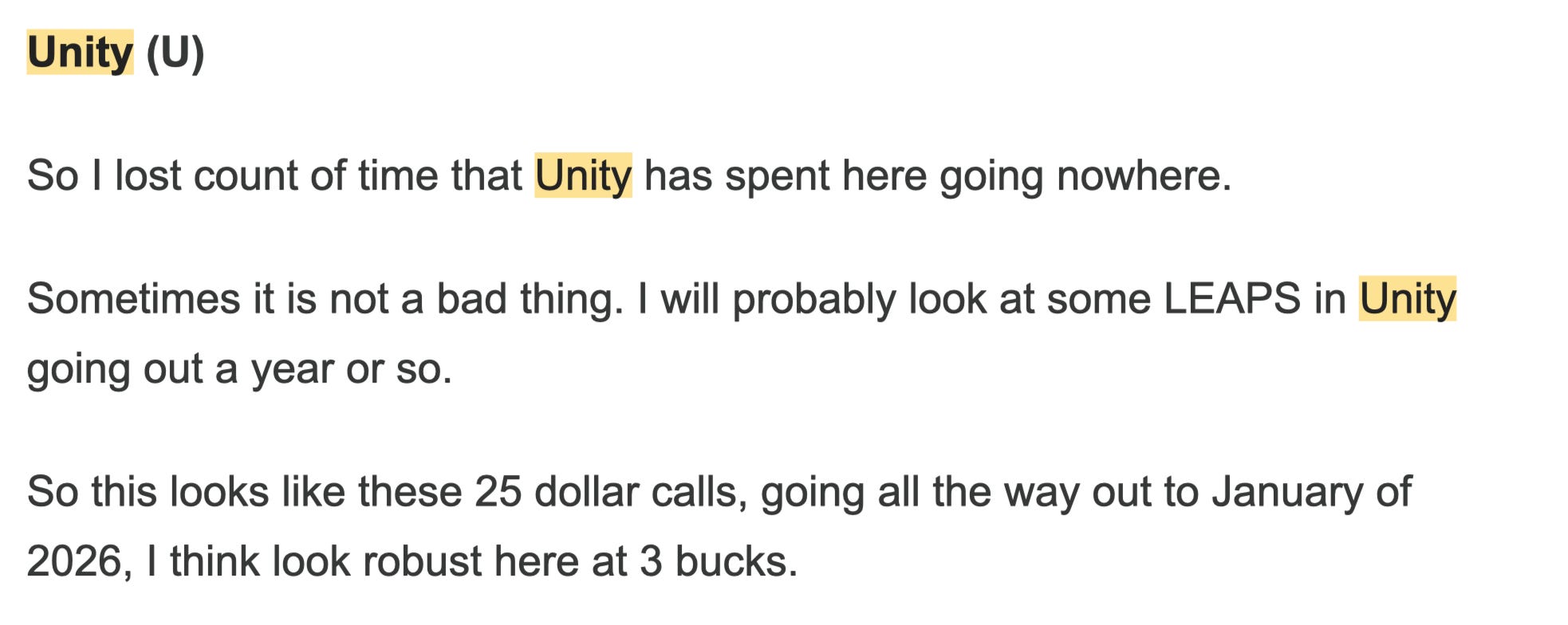
It doesn’t mean it cannot squeeze some more upside here.
I think these November MOPEX $45 Calls if had for $2 or so make sense from risk to reward.
NKE
I think NKE at $35 is likely closer to a meaningful low. Now earnings are next week so there can be knee jerk downside but as we approach low 30s , I think there is value here.
These $35 January 2028 LEAPS if had $3 to $5 make sense from risk to reward.
With Nike, here is what investors need to grapple with— is the current 7-8% margin the new normal or it’s an aberration?
Historically, as recently as 2022, Nike has had 12-14% margins. If one believes that the company can recover those type of margins again, then even at a 15 multiple you are looking at a 80 billion dollar company, not a $50 billion one. That could give it at the very least a $50-$55 fair value. Now this will not be a quick turnaround in my opinion, but the stock so close to $30 here in my opinion offers a compelling story if I had a 2-3 year time frame.
Have a great week ahead!
~ tic

Disclaimer: This newsletter is not intended to provide trading or investment advice but solely for general informational & educational purposes. It represents the personal opinions of the author, shared publicly with you as a personal blog. Engaging in futures, stocks, or bonds trading involves significant risk, and there is no guarantee of profit. In fact, there is a possibility of losing one’s entire investment. Utmost caution is advised. Your account can go to zero. The author does not guarantee any profit whatsoever, and the reader assumes the entire cost and risk of any trading or investing activities undertaken. The reader is solely responsible for making informed investment decisions. The owners/authors of this newsletter, its representatives, principals, moderators, and members are not registered as securities broker-dealers or investment advisors with the U.S. Securities and Exchange Commission, CFTC, or any other securities/regulatory authority. Consultation with a registered investment advisor, broker-dealer, and/or financial advisor is recommended. By accessing and utilizing this newsletter or any of its publications, the reader agrees to the terms set forth herein. Any screenshots used are courtesy of Ninja Trader, FinViz, Think or Swim, and/or Jigsaw, with whom the author has no affiliations. The information and quotes shared in this blog may contain inaccuracies, as markets are inherently risky and subject to unpredictable fluctuations. Additionally, the content of this blog is the intellectual property of the author, and its sharing or copying is strictly prohibited. By reading this blog, the reader accepts these terms and conditions and acknowledges that it is intended solely as a personal trading journal and nothing more.