
A tremendous amount of ink was spilled and eyeballs were glued to the Fed decision to raise rates by a quarter percentage point last week, with many experts calling this the start of a new tightening cycle.
The markets sold off quite aggressively on the news, but most of those losses were recovered in the latter part of the week, quite nicely coinciding with my weekly support levels shared last week.
To make long-term calls based on one Fed decision requires a certain stretching of the imagination, but if I were a betting man, I would say there is perhaps going to be one more rate hike this year, primarily to tamper down higher prices due to higher oil prices.
Now, the merits of such a rate hike, and its effectiveness in curbing oil prices and hence runaway inflation, are beyond the scope of this publication. But suffice it to say, rate hikes will have virtually little to no effect on oil prices whatsoever. The Fed can raise rates all it wants, but it cannot produce another barrel of oil, reopen a shipping route or repair a bombed pipeline. It can suppress demand elsewhere in the economy, but it cannot fix the source of a supply-driven oil shock.
The other angle worth considering here is the fact that, regardless of yields or borrowing costs, the hyperscalers and frontier labs continue to go out into the markets and borrow at unprecedented levels. The Fed raising rates will have absolutely zero impact on their activities. They will continue to borrow more in order to spend more.
Here is the part that gets overlooked. In just the past year, the major U.S. hyperscalers have issued roughly $220 billion in bonds as the AI infrastructure race has accelerated. So far, higher yields have clearly not stopped the spending machine.
The reason for this bravado may not necessarily be that they are confident in their own future gains. Instead, this needs to be seen more as a race to the bottom over who gets there first and who wins the most. A lot of this is also driven by anti-China animosity, which, in my mind, is partly being used as a way to gain sympathy and support from the populace for normalizing data center growth. Washington itself increasingly talks about AI in national-security terms and as a technological race that the U.S. cannot afford to lose. Whether that justifies the amount of money being thrown at the problem is another question entirely.
Now, I am not a doomer when it comes to AI. I think it serves a purpose, and I think it is important. Where I disagree with the zeitgeist and the mainstreamers is on one question: how do we get there?
The mainstream answer is to throw money and hardware at it. In my mind, the job could be done just as effectively, if not more effectively, through better engineering rather than enormous amounts of debt and spending.
However, this being America in 2026, the answer to the AI question, just like the answer to many other questions, seems to be DEBT DEBT DEBT and SPEND SPEND SPEND.
The Fed raising rates is unlikely to suddenly stop these companies from spending, but it does make the eventual bill larger. And we are already beginning to see some cracks around the edges. ORCL being the poster child of this excess.
Once the AI dust settles and the winners become apparent, the question becomes what happens to all this infrastructure and debt if the returns fail to justify the spending. That, in my mind, is where the real risk sits. If the revenues don't eventually show up, today's AI capex boom could become tomorrow's credit and equity problem. Think over capacity.
To summarize this section: Yes, the Fed raising rates is an issue, but do not expect it to meaningfully slow down the so-called “AI investment” in the U.S. The hype is real, and the players want the party to continue into the wee hours so people can keep buying GPUs and RAM and overbuilding data centers.
The charade cannot be allowed to end until it ends on its own — death by the natural causes of leverage, debt, over buildout and lack of demand. A heady mixture.
I am also in the camp that thinks there will not be a large number of rate hikes from here. Maybe one or two more.
The other elephant in the room remains the escalating geopolitical tensions in the Middle East and Eastern Europe.
Most of you probably already know the crux of the matter here, unless you have been living under the proverbial rock, so I will not rehash everything. But a few recent developments are worth noting.
The U.S. defensive positioning in Greenland, the perceived pullout of several thousand troops from Europe, and the most recent aggressive stance by Ukraine against Russia, despite U.S. suggestions not to target energy infrastructure.
Individually, these developments cannot all be explained. Taken together, however, they suggest that the geopolitical chessboard is moving rather quickly.
There is also a political backdrop that cannot be ignored. The midterms are now roughly six weeks away, Trump's approval in the latest Reuters/Ipsos poll was 35%, and Democrats held a seven-point advantage on the generic congressional ballot. Whether that has anything to do with foreign-policy decisions is impossible to know, but the timing is worth keeping in mind.
To counter this, it is not a stretch of the imagination to see the wars in Europe and the Middle East escalate further.
Think about it this way: despite the setbacks involving Iran, if this war were going to end quickly, it probably would have ended by now. The fact that it has not, and that tensions continue to escalate, suggests there could still be considerably more instability ahead.
So all in all, I think the risk of further escalation over the next few days and weeks is considerably higher than the market may be comfortable admitting. I don't think we should assume that the geopolitical situation simply fades quietly into the background.
If you are still with me, here are a few key takeaways from this weekend’s post:
Yes, the Fed has come in hawkish. Yes, they raised rates, and I think they will raise again. This will have very little meaningful impact on oil-driven inflation or AI spending until the bill arrives and there is no one left to pay it.
Fed hawkishness will hurt small businesses and everyday people. While it is premature to say it will cause a recession, it could contribute to recessionary conditions in several sectors and industries. Housing, for instance, is one area where higher rates will likely dampen what little activity remains.
Geopolitical tensions remain a major risk. We could see the conflicts intensify and potentially spread across a wider geographical area.
Emini levels
As we saw earlier this week, there may be demand for the S&P500 and QQQ type names on dips. As I said several weeks ago, this whole zone around 7350-7403 remains important. These are emini December levels.
We last closed at 7726 on the week.
If we are going to build on the gains from last week, it is crucial we clear 7750 early on in the week else this may remain resistance unless broken via a close on daily and weekly time frames above 7750.
On the downside, if we retest recent lows near 7500, these may remain supported until broken.
At any rate, I will not be too bearish here unless we break 7403, and we could remain balanced here between 7400 and 7800 until directional clarity comes beyond this zone.
What else benefits from this dynamic?
The alternate monies
Both Gold and Bitcoin can win.
Names like MSTR can win as long as we hold 120s on MSTR. It is 150 or so now. I think 220 may be poss.
I think we should begin to see Bitcoin make another run towards 93-94K. It is about 80K at the moment. It is up quite handsomely from 60K support shared several months ago.
I personally think once we see a weekly close above 94K on Bitcoin it is going to go and retest 100K.
AI
The US economy now is synonymous with the AI trade. I do not expect a letdown in spend until an official recession changes reality.
Look at Micron for instance. See below for my post a few weeks agao. Every dip in Micron has been supported since then.
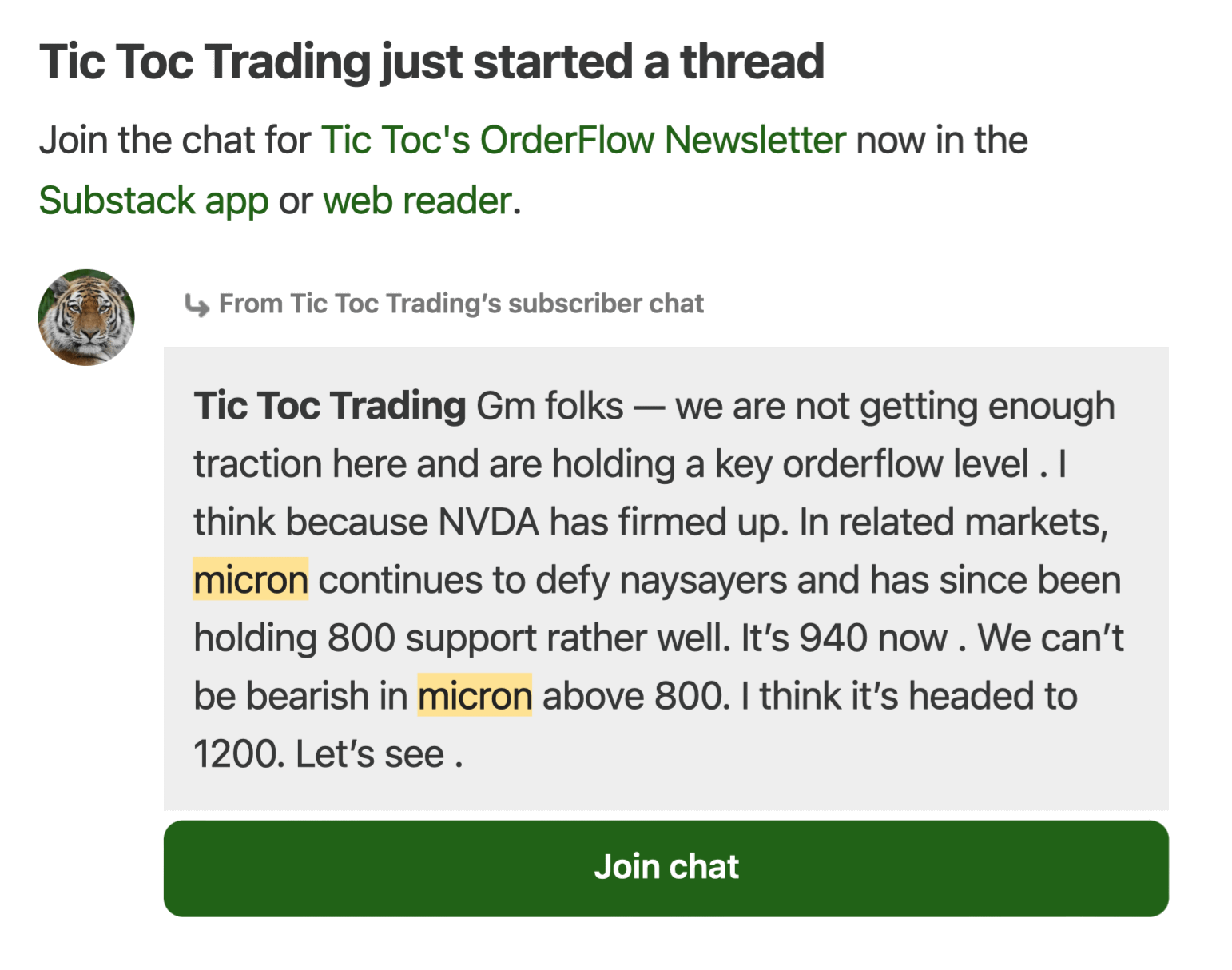

I will expect Micron to make another swipe at 1200 and a few closes above 1200 I think pave the way for 1400 on Micron.
Look at similar AI names that have been subdued recently like AMAT. I think the setup here looks good at 440 as long as 400 holds for another swipe at 550.
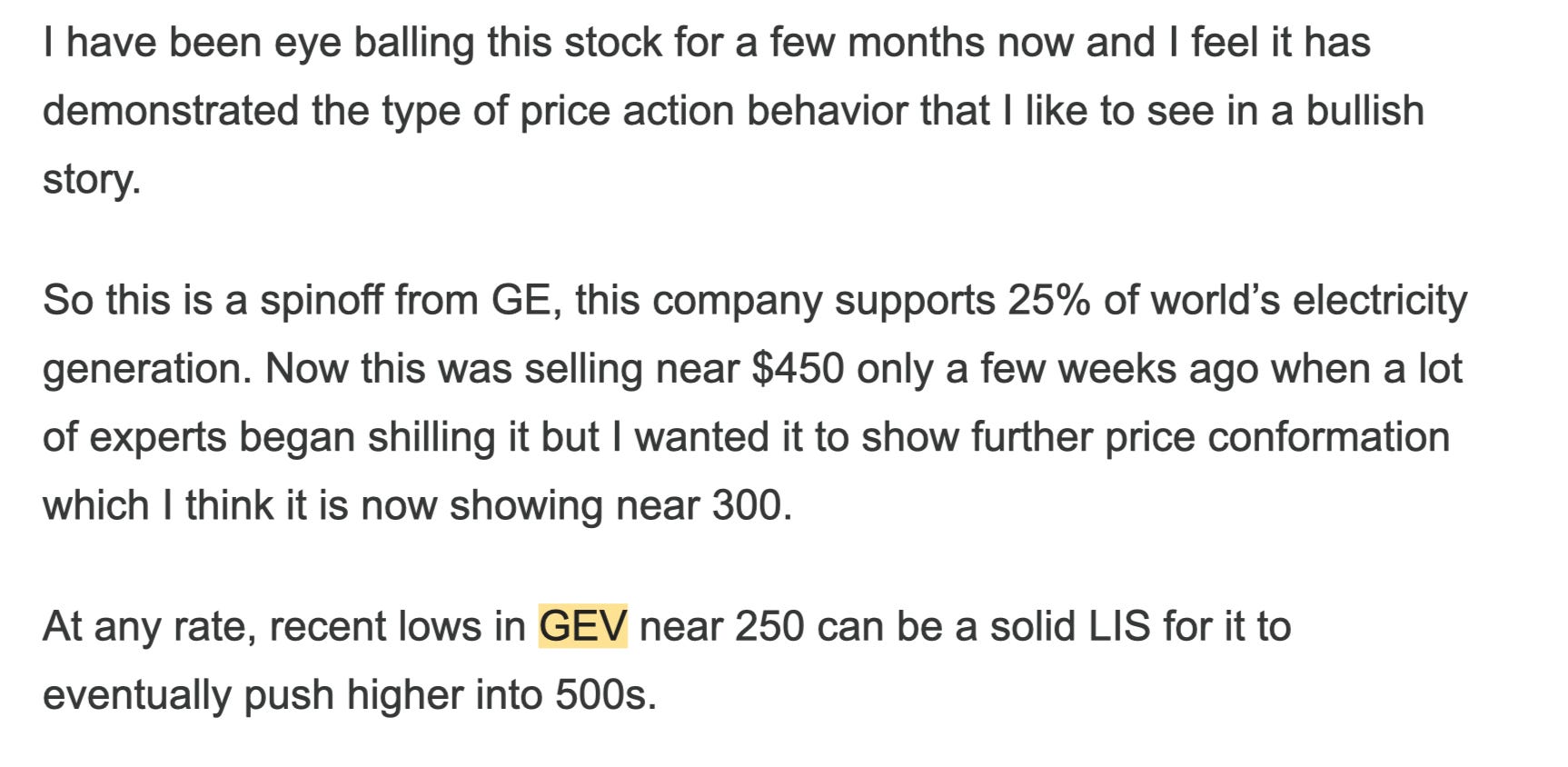
GEV/ETN
These are much older orderflow stocks. See below.
If the AI and CAPEX story falls apart, I think GEV still remain relevant.
~ tic
Disclaimer: This newsletter is not intended to provide trading or investment advice but solely for general informational & educational purposes. It represents the personal opinions of the author, shared publicly with you as a personal blog. Engaging in futures, stocks, or bonds trading involves significant risk, and there is no guarantee of profit. In fact, there is a possibility of losing one’s entire investment. Utmost caution is advised. Your account can go to zero. The author does not guarantee any profit whatsoever, and the reader assumes the entire cost and risk of any trading or investing activities undertaken. The reader is solely responsible for making informed investment decisions. The owners/authors of this newsletter, its representatives, principals, moderators, and members are not registered as securities broker-dealers or investment advisors with the U.S. Securities and Exchange Commission, CFTC, or any other securities/regulatory authority. Consultation with a registered investment advisor, broker-dealer, and/or financial advisor is recommended. By accessing and utilizing this newsletter or any of its publications, the reader agrees to the terms set forth herein. Any screenshots used are courtesy of Ninja Trader, FinViz, Think or Swim, and/or Jigsaw, with whom the author has no affiliations. The information and quotes shared in this blog may contain inaccuracies, as markets are inherently risky and subject to unpredictable fluctuations. Additionally, the content of this blog is the intellectual property of the author, and its sharing or copying is strictly prohibited. By reading this blog, the reader accepts these terms and conditions and acknowledges that it is intended solely as a personal trading journal and nothing more.